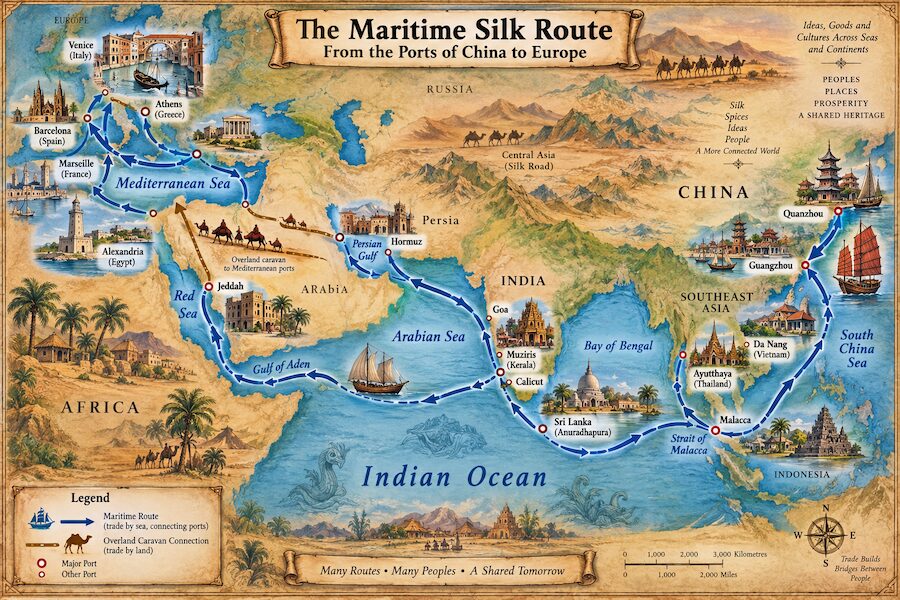
Ships on the Maritime Silk Road reached Europe by a long sea route that linked the South China Sea all the way to the Mediterranean, generally following these legs:1. Departure from East Asia
Ships set out from Chinese ports (Quanzhou, Guangzhou, later also Southeast Asian entrepôts) carrying silk, porcelain, tea, and spices.2. Through Southeast Asia
Vessels sailed south through the South China Sea, stopping at ports in Vietnam, and the Malay Peninsula/Indonesia (Malacca, Srivijaya), where the Strait of Malacca served as the critical chokepoint funneling trade between East and South Asia.3. Across the Indian Ocean
From there, ships used the monsoon winds to cross the Bay of Bengal to Indian ports (on the Coromandel and Malabar coasts, and Sri Lanka), which functioned as major transshipment hubs where goods were often transferred between different ships and merchant networks.4. To the Arabian Sea and Persian Gulf / Red Sea
Continuing west, ships sailed to the Arabian Peninsula, either:• up the Persian Gulf to Basra and then overland to Baghdad and the Levant, or
• up the Red Sea to Egyptian ports like Jeddah and then to Cairo/Alexandria.East African ports (Mombasa, Zanzibar, Kilwa) were also linked into this network.5. Final leg into the Mediterranean and Europe
From the Middle East, goods usually completed their journey to Europe in one of two ways:
• Overland/short-hop: goods were offloaded at Red Sea or Persian Gulf ports, carried by caravan to Mediterranean ports (Alexandria, Beirut, Antioch), and then shipped by Italian merchant fleets (Venetian, Genoese) across the Mediterranean to Europe.
• Mixed sea-land route through the Gulf: goods landed at Basra, went overland to Aleppo or Damascus, then to Mediterranean ports for the final sail to Venice or Genoa.So, for most of history, no single ship sailed directly from China to Europe — cargo moved in stages through a relay of regional fleets and ports, changing hands (and often ships) multiple times, with the final Mediterranean-to-Europe leg typically carried by Arab, and later Italian, merchant vessels. It wasn’t until the Portuguese pioneered the all-sea route around the Cape of Good Hope (Vasco da Gama, 1498) that ships could sail directly from Europe to Asia without the overland Middle Eastern relay — which is part of why that route is often treated as a turning point that eventually diminished the older relay-based Maritime Silk Road.