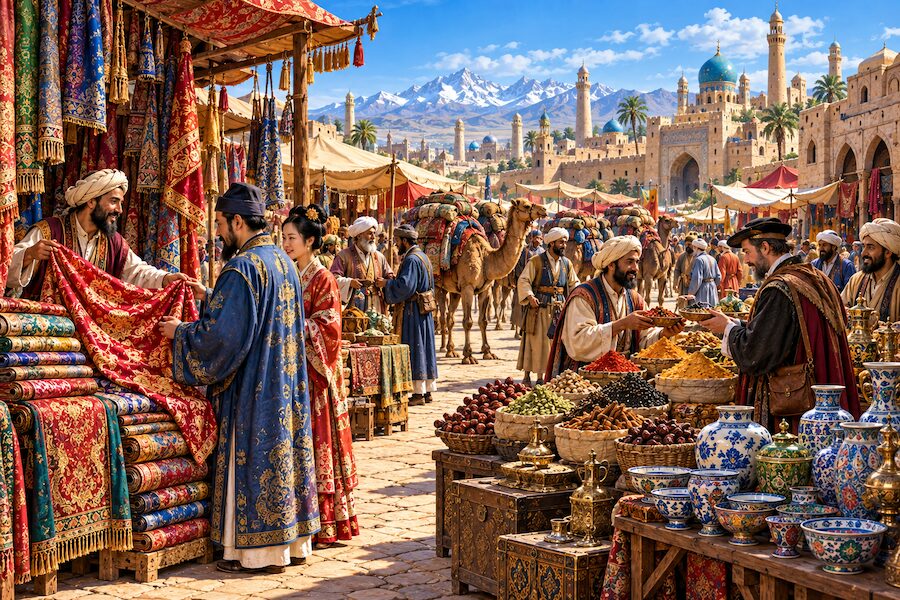
The Silk Roads emerged gradually rather than being founded at a single moment. Overland trade between China and Central Asia is traditionally dated to around 138–126 BCE, when the Han dynasty envoy Zhang Qian was sent west and returned with knowledge of the lands and trade networks beyond China’s borders, opening official contact with Central Asia. Over the following centuries, a relay of caravan and sea routes connected China, India, Persia, Arabia, and the Mediterranean, carrying silk, spices, paper, gunpowder, and religious ideas (Buddhism, Christianity, and later Islam) alongside goods. The network reached a high point under the Mongol Empire in the 13th–14th centuries, when a single political authority stretching from China to Eastern Europe made overland travel unusually safe, a period often called the “Pax Mongolica.”
It was in this Mongol-era environment of relative safety that the Venetian merchant Marco Polo traveled to China, departing in 1271 and reaching the court of Kublai Khan by 1275, where he reportedly remained for years before returning to Venice in 1295. A few years later, Polo was captured during a conflict between Venice and Genoa and held as a prisoner of war in Genoa, where, around 1298, he dictated his account of his travels to a fellow prisoner, the writer Rustichello da Pisa. The result, known as The Travels of Marco Polo (or Il Milione), became one of the most influential travel accounts in European history, shaping European imagination of Asia for centuries — even though many of its more fantastical claims have long been debated by historians.
Just over a century later, the Maritime Silk Road saw its most ambitious expansion under the Ming dynasty admiral Zheng He, who led seven massive naval expeditions between 1405 and 1433, commanding fleets of hundreds of ships and tens of thousands of sailors — far larger than anything Europe would produce for another century. His voyages reached Southeast Asia, India, the Arabian Peninsula, and the coast of East Africa, projecting Chinese naval power and opening diplomatic and trade relations across the Indian Ocean world. However, after Zheng He’s death and a shift toward isolationist policy under later Ming emperors, China largely withdrew from long-distance maritime expansion, leaving a vacuum that European powers — beginning with Portugal’s voyages around Africa later in the 15th century — would eventually fill.
By the time the Ottomans took Constantinople in 1453, disrupting the overland route’s link to the Mediterranean, and Portuguese explorers like Vasco da Gama opened an all-sea route to Asia in 1498, the old relay-based Silk Roads were already giving way to a new age of direct European maritime trade — closing one chapter of Eurasian connectivity and opening another.