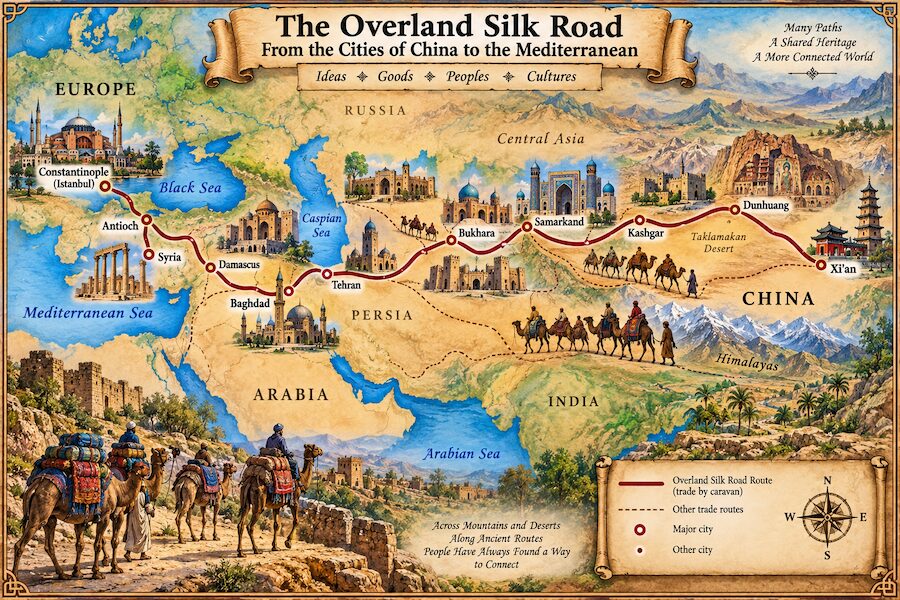
The Overland Silk Road linked China to Europe through a relay of caravan routes across Central Asia and the Middle East, generally following these legs:1. Departure from China
Caravans set out from Chinese cities such as Xi’an (Chang’an), the traditional eastern terminus, carrying silk, tea, porcelain, and lacquerware westward.2. Through the Gansu Corridor and Tarim Basin
Routes passed through the Gansu Corridor (via Dunhuang) and then split around the Taklamakan Desert into a northern route (skirting the Tian Shan mountains through Turpan and Kashgar) and a southern route (via Khotan and Yarkand), both converging again near Kashgar.3. Across Central Asia
From Kashgar, caravans crossed the Pamir Mountains into Central Asia, passing through the great oasis cities of the Fergana Valley and Transoxiana — Kashgar, Samarkand, Bukhara, and Merv — which served as major trading and transshipment hubs where goods, animals, and often entire caravans changed hands.4. Into Persia
Routes continued west through Persia (Iran), passing through cities like Mashhad, Nishapur, and Rey (near modern Tehran), toward Ctesiphon/Baghdad in Mesopotamia — a key hub linking the eastern routes to the Mediterranean world.5. To the Levant and Anatolia
From Mesopotamia, caravans pushed onward through:
• Syria and the Levant (Damascus, Aleppo, Antioch), or
• Anatolia (through Persia’s northern routes into eastern Turkey and on to Constantinople).These cities served as the last major inland relay points before goods reached Mediterranean or Black Sea ports.
Final leg into Europe
From the eastern Mediterranean, goods completed their journey to Europe by sea, carried largely by Byzantine and later Italian merchant fleets (Venetian and Genoese) from ports like Antioch, Tyre, Trebizond, and above all Constantinople, across the Mediterranean to Venice, Genoa, and other European trading cities. From there, goods moved further into Europe via inland trade networks (over the Alps and along river systems).
So, like the maritime route, no single caravan traveled the entire distance from China to Europe — the Overland Silk Road was also a relay system, with goods passing through the hands of many regional merchants (Sogdian traders were especially prominent middlemen in Central Asia) and often being repackaged, re-traded, or taxed at each major oasis city along the way. Constantinople functioned as the great hinge point where the overland route met Mediterranean shipping into Europe, similar to the role Mediterranean ports played for the maritime route — until the Ottoman conquest of Constantinople in 1453 disrupted this link and helped spur Europeans to seek all-sea alternatives, including the maritime route around Africa.